Drag Rivals: Tuning & Racing
- 4.3
- Rating
- 10.00K
- Installs
- Free
- Price

 Analysis by App-foxy
I approached Drag Rivals: Tuning & Racing as a quick-session racing game rather than a full driving simulator. That distinction matters immediately. Its focus is the drag battle: prepare a car, make tuning choices, and try to produce a faster run than the opponent. I found the appeal strongest when I wanted a concentrated burst of competition instead of a long circuit race that demands several uninterrupted minutes.
The game is free to download, and RETROBOT s.r.o. presents it for an Everyone audience. It belongs to the racing category, but it is a very specific kind of racer. You are not choosing it for open-world exploration or realistic cornering. You are choosing it for the small decisions around acceleration, timing, and car preparation. That narrow focus gives it a clear identity, although it also means some players will quickly discover that it is not the racing experience they expected.
What to consider before choosing this drag racer
My first decision test is simple: do you enjoy improving a short run through repeated attempts? Drag racing works best for players who like watching a small adjustment change the result. If your idea of fun is learning a track, braking late, and carrying speed through bends, a traditional circuit racer will probably offer more variety. Here, the excitement comes from making the launch and acceleration phase count.
You May Also Like

 AccuWeather: Weather Radar
AccuWeather Review: A Quick, Clear Forecast for Everyday Decisions
For everyday plans, the best forecast is the one you can understand quickly. AccuWeather makes rain timing, radar, and local conditions easy to act on, with a few trade-offs.

 Hill Climb Racing
Why Hill Climb Racing Still Turns Crashes Into One More Run
A tiny car, a bumpy hill and one more upgrade: Hill Climb Racing keeps resurfacing because its simple chaos makes every near-miss feel personal.

 AliExpress - Shopping App
AliExpress Makes Global Shopping Feel Personal, but Shoppers Bear the Risk
AliExpress turns a global marketplace into a pocket-sized discovery engine. Its reach is useful, its shopping loop compelling, and its trade-offs easy to miss.

 Lords Mobile: Kingdom Wars
Lords Mobile Is a Kingdom-Building Routine, Not a Quick Match
A case-by-case verdict on the building, battles, device demands, and social commitments that make Lords Mobile rewarding for some players and exhausting for others.

 PDF Scanner app - TapScanner
TapScanner Makes Paperwork Easier to Capture, Check, and Share
TapScanner makes scanning with a phone feel less like a rescue operation and more like a dependable step in getting work done. Its capture tools are useful, though not flawless.

 Block Blast!
 Shows How Much a Puzzle Game Can Leave Out
A quiet grid game shows why puzzle players increasingly value instant clarity, repeatable skill and low-pressure play—and where the genre still needs to catch up.
More From Our News Desk
View All News


The second test is tolerance for repetition. A drag battle can be easy to understand, but that does not make every attempt feel identical. The interesting part is the preparation between races: deciding what deserves attention, noticing where a run went wrong, and resisting the temptation to change everything at once. I recommend treating each attempt as a small experiment. Adjust one element, race again, and see whether the result improves. That approach is more satisfying than making random changes and hoping the car suddenly feels faster.
The third test is how you feel about optional spending. The game is free, with in-app purchases listed at $5.99 per item. That does not automatically make the experience unsuitable, but it is worth deciding in advance whether you want to play within the free path or consider purchases when progress feels slower. I prefer setting that boundary before starting, because a tuning game can make every improvement feel tempting when you are already invested in a car.
There is also a practical compatibility point. The current version is 0.5.8 and the game requires Android 6.0 or later. That makes it accessible to a broad range of Android devices, though performance and comfort can still vary from one phone to another. On a smaller screen, precise actions may feel less comfortable during a tense run, so I would test the controls for a few races before deciding whether it deserves a permanent place on your device.
The public response is still difficult to use as a buying signal. The displayed average rating is 0.0, while the game has passed 10K installs. I would not interpret that rating alone as evidence that the game is poor; it simply gives me very little useful community guidance. In this situation, the best decision comes from matching the game’s focused drag format to your own habits rather than relying on a rating snapshot.
Why the focused format can be satisfying
Drag racing has a useful advantage over broader racing games: it gives every run a clear purpose. You are not wondering whether you lost because of one missed corner, a poor route, traffic, or a mistake several minutes earlier. The result feels tied to a compact sequence of choices. That clarity makes it easier to learn from failure, especially when you are playing in short bursts.
I also like the way the format encourages deliberate tuning. A car is not merely a visual reward that sits in a garage. It becomes a problem to solve. If the launch feels weak, I look at the preparation rather than blaming the track. If the car seems strong at the start but loses its advantage, I reconsider how I am approaching the run. This creates a useful loop for analytical players who enjoy connecting a change with a result.
One practical tip is to keep a mental record of what changed before a better run. You do not need a spreadsheet. Simply remember whether the improvement came after a tuning adjustment, a different launch approach, or a more careful sequence of inputs. Without that discipline, it is easy to confuse coincidence with progress. That is one of the hidden trade-offs of a compact racing game: the controls may be approachable, but meaningful improvement still benefits from attention.
Where it fits into an ordinary day
I can see this working well during a short break when I want a game with a beginning and an end to each attempt. A commute, a waiting room, or a few minutes before bed are natural situations for a drag racer because the format does not ask me to memorize a large map before I can enjoy it. I can make a run, think about the result, and stop without leaving a long race unfinished.
That same convenience can become a weakness. If you prefer games that create a strong sense of place, a large collection of tracks, or long-form progression, the concentrated format may feel thin. Drag battles are excellent at giving a quick competitive question—can this car win this run?—but they are not automatically a substitute for a more expansive racing game.
Where Drag Rivals stands out among racing alternatives
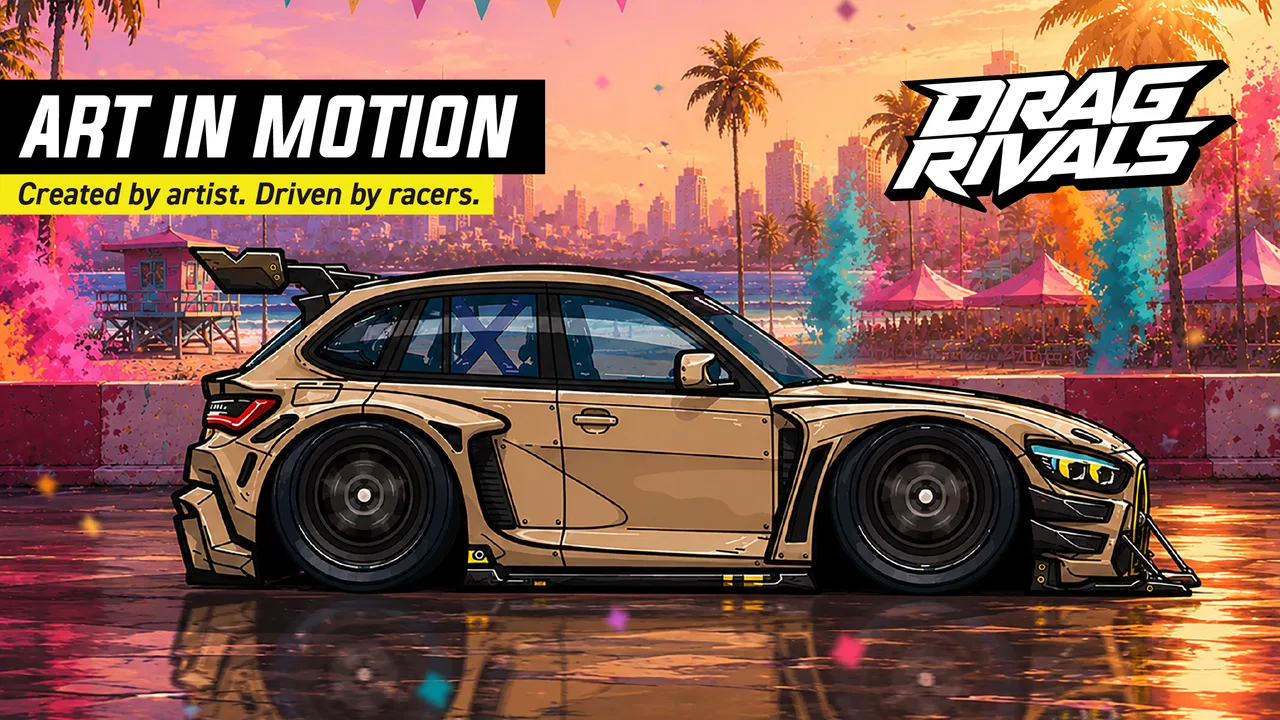
The clearest strength is its commitment to one racing idea. Many mobile racers try to combine driving, collecting, exploration, stunts, and customization into a single package. This game instead puts the emphasis on powerful cars, tuning, and head-to-head acceleration. I find that easier to understand and easier to recommend to someone who specifically enjoys drag racing rather than racing games in general.
It also has a different rhythm from a conventional arcade racer. In a circuit game, the main skill is often maintaining a clean line while managing several corners. Here, preparation and execution are compressed into a shorter contest. That makes the game feel less demanding in terms of time, but potentially more demanding in terms of repeating a small sequence until it works. Players who like immediate feedback may prefer this structure.
The customization angle gives the battles more meaning than a simple reaction test. A win is not only about tapping at the right moment; it is also connected to how you have prepared the car. The important insight is that customization should be treated as a strategy, not decoration. I would avoid spending resources on every available improvement at once. Concentrating on the weakness that is actually costing races should make each decision easier to evaluate.
Another strength is the accessibility of the premise. You do not need to understand racing lines or vehicle dynamics before starting. The central question is familiar: make the car perform better and beat the rival. That makes it suitable for someone who wants a racing game but does not want to study a complex simulation. The Everyone age rating also makes the presentation broadly approachable for families, although adults should still make their own judgment about optional purchases.
Small decisions that improve the experience
My preferred workflow is to race first, diagnose second, and tune third. It is tempting to open the customization side immediately and improve whatever looks available. That can make the garage feel productive, but it does not tell you whether the change solved a real problem. A baseline run gives you something to compare against. After that, make one meaningful adjustment and return to the same kind of challenge.
I would also avoid judging a car after one disappointing attempt. Short races can magnify a single mistake, and a poor result may say more about execution than the vehicle itself. Two or three consistent runs give a better impression. This is especially important for players who normally switch cars whenever progress slows. In a tuning-focused game, learning the behavior of one car can be more valuable than constantly starting over with another.
Another useful practice is separating immediate wins from long-term value. A change that helps one battle may not be the best direction for future races. If the game presents several ways to improve a vehicle, I would favor choices that make the car easier to use consistently rather than chasing a single spectacular result. Consistency is often more useful than a setup that works only when every input is perfect.
When a different racing category is better
I would point a fan of realistic driving toward a simulation-style racer instead. A drag-focused game cannot replace the satisfaction of managing corners, braking points, tire behavior, or changing track layouts. If those details are the reason you play racing games, this title’s narrow format may feel like a limitation rather than a strength.
For someone who wants exploration, an open-world racer is a better match. The pleasure there comes from moving through a space, finding routes, and discovering activities. Drag Rivals: Tuning & Racing is more deliberate and contained. It asks you to improve performance for battles, not to wander through a large environment.
Even fans of arcade racing should consider their preferred session length. A circuit racer may offer more visual variety within one event, while this game may offer more room to refine a particular competitive loop. Neither approach is universally better. I would choose this one when I want focused repetition and choose the broader alternative when I want changing scenery and more varied driving tasks.
What the free entry and purchases mean in practice
Starting without an upfront price is a genuine advantage. It lets me see whether the drag format suits me before committing money to a premium racing game. That is particularly useful here because the concept is specialized. Someone may enjoy racing games but dislike repeated acceleration battles; a free starting point reduces the risk of discovering that mismatch too late.
The trade-off is the presence of $5.99 purchases per item. I would approach them as optional accelerators rather than part of the basic definition of the game. Before buying anything, I would ask whether the purchase solves a real frustration or merely shortens a period of learning. If I am still unsure which car or tuning direction I enjoy, spending early seems premature.
A sensible way to manage the cost is to play long enough to identify the bottleneck in your progress. Is the problem that the car is underprepared, that your timing is inconsistent, or that you simply have not learned the format? Those are different problems, and a purchase may not address the latter two. The most valuable spending decision is the one made after you understand what is holding you back.
This is also where the game differs from a one-time premium racer. A premium alternative may cost more at the beginning but provide a clearer sense of ownership and fewer purchase decisions during play. On the other hand, it may not offer the same low-risk trial. I would choose the free model here if I value experimentation and short sessions; I would choose a premium option if I strongly prefer a complete package from the start.
Who should download it
I think the best audience is someone who enjoys car progression, quick competitive rounds, and the satisfaction of making a small setup change produce a better result. It is also a good fit for players who want a racing game that can be played in compact sessions without requiring a full event every time they open it.
It may suit a casual player who has never tried drag racing, because the basic objective is easy to grasp. The deeper enjoyment comes from deciding how seriously to take the tuning loop. You can approach each race casually, or you can use repeated runs to understand what is improving the car and what is merely adding noise to your decisions.
I would skip it if you need elaborate tracks, free driving, realistic handling, or a large variety of race types. I would also be cautious if repeated attempts feel frustrating rather than rewarding. The game’s central loop depends on wanting to try again after a loss. If your ideal racing session is about constant novelty, a broader arcade racer will probably keep you engaged for longer.
My recommendation after weighing the trade-offs
My recommendation is conditional but positive: try it if the words drag battles and car tuning describe the part of racing games you already enjoy. The free entry makes that experiment straightforward, and the focused structure gives it a recognizable personality. I especially like it as a short-session game for players who enjoy turning a defeat into a practical question about setup or execution.
I would not recommend downloading it blindly to replace every other racing game on your phone. Its strength is specialization, and specialization always leaves something out. It does not aim to be the best choice for exploration, simulation, or track variety. The right comparison is not whether it contains everything a racing fan might want, but whether its particular loop is the one you want to repeat.
My final advice is to begin with a no-spend trial, pay attention to how much you enjoy the tuning decisions, and judge the game by several consistent runs rather than one result. If you find yourself thinking about why a car lost and what you can change next, that is a strong sign the design is working for you. If you are only waiting for the game to become a conventional circuit racer, switching to another category will be the better decision.
With its current version 0.5.8, RETROBOT s.r.o.’s game is best understood as a focused, accessible entry into drag racing on mobile. I would recommend it to patient players who like compact competition and incremental improvement, while steering fans of open roads and technical cornering toward alternatives built around those experiences. For the right player, that narrow focus is not a missing feature; it is the reason to play.
FAQs for Drag Rivals: Tuning & Racing
01What is Drag Rivals: Tuning & Racing about?
Drag Rivals: Tuning & Racing is a high-octane racing game that focuses on drag racing. Players can customize and upgrade a variety of cars to compete in intense races. The game emphasizes precision in gear shifting and acceleration, rewarding skill and timing. It combines realistic graphics with engaging gameplay.
02Is Drag Rivals: Tuning & Racing free to play?
Yes, Drag Rivals: Tuning & Racing is free to download and play on both Android and iOS devices. However, the game offers in-app purchases, allowing players to buy in-game currency and exclusive items. These purchases can enhance the gaming experience but are not necessary to progress.
03What customization options are available in the game?
The game offers extensive customization options, allowing players to modify their cars' performance and appearance. Players can upgrade engines, tires, and nitrous systems for better speed and handling. Cosmetic options include paint jobs, decals, and body kits, enabling a personalized racing experience.
04Does Drag Rivals: Tuning & Racing require an internet connection?
While Drag Rivals: Tuning & Racing can be played offline for single-player races, an internet connection is required for certain features. Multiplayer racing, leaderboards, and in-game events depend on connectivity. For the full experience, it's best to have an internet connection available.
05Are there any multiplayer features in Drag Rivals: Tuning & Racing?
Yes, the game includes robust multiplayer features, allowing players to compete against each other in real-time races. There are leaderboards to track global rankings and special events where players can challenge others and showcase their customized cars. This adds a competitive edge to the game.
Pros
- Stunning graphics enhance racing experience.
- Extensive car customization options available.
- Realistic physics for authentic driving feel.
- Diverse tracks keep gameplay exciting.
- Multiplayer mode adds competitive edge.
Cons
- In-app purchases can be quite expensive.
- Occasional lag issues during multiplayer.
- Requires constant internet connection.
- Limited storyline for single-player mode.
- High battery consumption during play.

Drag Rivals: Tuning & Racing
Gallery